Six of Sparrows
Welcome to the devlog for my game called Six of Sparrows.
It will be a short one, as the game was developed rather quickly and considered more of a “mini game” in-between bigger game projects. Nevertheless, the game turned out more than good enough, otherwise you would’ve never even known of its existence ;)
You can also check out the (very brief) devlog for Bidding Blocks that talks more about the original idea that spawned this game as a sort of “spin-off” or “twin game”.
What’s the idea?
Simplifying Poker
People like poker. Nobody remembers (or wants to remember) all the possible combinations and how they score, nor do they actually like the bluffing aspect.
Of course, this depends on your group of people. But almost everyone with whom I’ve ever played poker did basically no bluffing at all.
- They looked up what they had in the instruction manual.
- If they bid nothing/small, they had nothing.
- If they bid big, they had something.
- If they went all-in, they had the best thing possible xD
- (They didn’t care a single bit about what I did. I could bluff all I want, bid a LOT without having any good cards, and they’d just stick to their original plans. At most, I get a few pennies because everyone pulled out immediately.)
Sure, it’s a way to play the game. But you really remove any strategy or gameplay poker had left, and turn it into nothing more than “get lucky with the cards”.
It’s also boring to have to wait until people have checked the manual again, and/or have discussions after revealing every time.
Again, depends on your players. But I’ve always been surrounded by players who need absolute extreme hand-holding to get through even the simplest of games, so that’s why I usually design incredibly simple games with that target audience in mind!
And so this idea started.
- A set of “Bid Cards” is on the table: these cards show specific poker combinations (and a few I made up for this game) and how much they score.
- One by one, players receive 1 card (to take into their hand) and the table receives 1 faceup card.
- After receiving a new card, anyone can decide to BID: they grab one of the Bid Cards available. (In other words, you’ve seen your cards and now hope to complete that pattern by the end.)
- When you do, however, you also grab the Bid Token with a number equal to how many cards you have in your hand.
- Your score at the end of this round is divided by the Bid Token.
- In other words, the earlier you bid, the bigger your score (if you manage to complete it). A nice tug-of-war between risk and reward.
- This continues until everyone has all their cards (and bids), at which point we reveal and score.
A very simple game loop. All the things you can score, and which ones are better, are literally displayed on the table for anyone to see and read.
At the same time, bad hands don’t really exist. If you feel your hand won’t amount to a high-scoring bid, then you can take the risk and claim an easy-to-complete bid very early. (If you have 6 cards in your hand, and 6 cards on the table, then something like “1 Pair” is almost guaranteed. Depending on how many cards I end up including, of course.)
Making it better
I briefly considered doing the same as I did for Bidding Blocks: just have people write down their bid + how many cards they held at the time on a piece of paper.
For this game, however, I wanted everything to be visible and tangible. Grabbing the Bid Card + the Bid Token is, for most people, a more clear and intuitive move in a game. It’s more final, it’s easier to understand.
It also cleans up that pen and paper for tracking only how many points you got (each round), instead of muddling it with extra calculations or numbers.
Finally, this is what actually gave me the idea to make Bid Tokens limited. If someone already bid with 4 cards in their hand, then you simply can’t. There’s only one token with that number.
This encourages players even more to do risky bids early on. Because if you don’t grab that risky bid card now … you might not be able to next round. (In case multiple players want to bid now, the one closest to dealer gets it.)
Now the entire game could be played with just a few cards (Playing cards + Bid Cards), all information was public and out in the open, but we already have many elements of interesting risk/reward decisions.
Having these fixed bid cards, however, limits the likelihood of having something. We don’t have access to all possible combinations from poker, no, only the ones on display this round. As such, we need to compensate and bring the probabilities up again by giving players more cards. That’s why everyone gets 6 in the hand + 6 open on the table.
This might be lowered to 5, but then the name “Six of Sparrows” doesn’t fit anymore, so meh :p
Finally, I added a few more bids that only work in my type of game. For example: “I will have more cards of suit X than anyone else”. This adds a bit more spice and a bit more interaction.
Expansions
I really want to keep the base game as simple as possible. Ideally, all my games should be setup and played within 5 minutes, even with complete newcomers.
That’s why I moved the following rules to tiny expansions, even though I consider them very useful.
- There are two bonus bids: “WIN ALL” and “WIN NONE”. You can grab these on top of your actual bid.
- The first one scores massive points if you end up being the BEST out of all players this round. But it’s risky, because failing to have the highest-scoring pattern will give you massive penalty points.
- The second one is for anybody who believes their cards are absolute rubbish. You score massive points if you end up not having any of the patterns available in this round. (Again, a slight balancing factor for bad luck.)
- In the base game, failing to grab a bid simply means … nothing. You can’t score points this round, nor can you lose points. It’s a fine compromise if you think your cards fit that strategy, but obviously a bit stale.
- Instead, the expansion adds multiple Bid Tokens with number 10.
- If you have no bid at the end of the game, you can still grab one (of the ones available).
- But you must also grab Bid Token 10, which means any score you’ll get will be diminished.
- This felt like a great compromise between giving players “second chances” or “a nice backup”, without ever being too friendly.
That last sentence says a lot, I think. Games are about fun and feeling good. Instead of being harsh on players or just saying “well you’re just unlucky / well you just played terribly”, make them feel good. Give them a nice backup plan or second chance, help the player in last place a little bit.
But do it in a subtle, simple way that’s not “too friendly”. Because then the other players will stop playing, because it’s worthless—you’ll receive massive bonuses when in last place anyway!
Anyway, this simple rule—you may still grab something, but its score is pretty much halved—accomplishes this nicely.
Let’s make that!
Generation
Nothing special here. Loop through suits, loop through numbers, create one card for each.
I have a massive list of all possible bids (including where to find their icon in my big image of illustrations + their textual explanation). It just loops through those and creats a Bid Card for each too.
I briefly considered having different bids be added in different numbers. For example, very easy bids like 1 Pair or 2 Pairs might be added more often to ensure players have something to go for. In practice, however, this made the deck of Bid Cards too large overall, and it’s really not needed when players can make their pattern out of 6 + 6 = 12 cards.
Drawing
The title of this game was inspired by the book Six of Crows. (Just the title; the content of that fantasy book has nothing to do with anything in this game.)
The cover has this vintage, grungy, font and art style. That’s why I chose to do the same thing for this game.
The cards look a bit worn, vintage, outdated, as if they were used to play this game a 1000 years ago too. The icons for suits and numbers had to look like they were always there, people just found them. The bidding patterns had to look like ancient, wise messages scribbled into a wall to be deciphered by players.
At least, that was the vision. I didn’t want to overcomplicate it, and could only spend little time on it anyway, so these were the sketches I did.
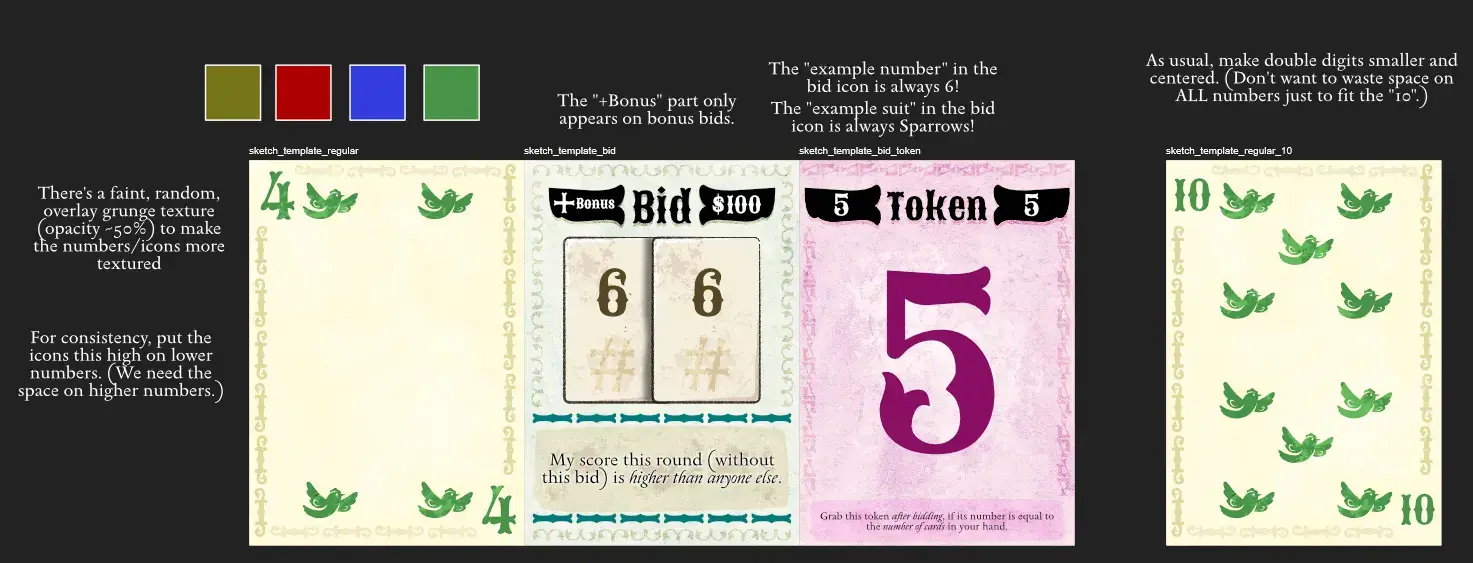
Close enough.
Simulation
As usual, I created an interactive example for the rulebook, which also allowed me to simulate the game. The computer plays 10,000 random turns/rounds and gives me the results. I mostly check for averages and probabilities of stuff (not) happening, just as a sort of “sanity check”.
In this case, I decided to forego the actual bid scoring in the example. It didn’t add anything to add a mess of words just to reiterate what the clear icon + text on the bid card already explains.
No, the most important part of this game—pretty much the only part—is the dealing+bidding phase. So that’s the thing the interactive example actually says.
That doesn’t mean the bids aren’t scored. They are properly calculated by the code! It’s just behind the scenes, and I only track that for the simulation. This was more work than I liked, but I had to be sure that the bids were actually achievable.
More specifically, for every round the computer randomly plays,
- I try every possible bid card for every player. (So it looks at their individual hand + open hand on table.)
- And register if that bid would be a success and score points, or not.
- Those probabilities are then converted to a “suggested value” (for the card) between 20 and 200. (Something with near 100% probability of being a success, only gives 20 points. Something with near 0% probability gives 200 points.)
What were the results?
For the most part, the bids were fine. (Achievable, a good spread of easy ones and really hard ones.)
There were some outliers, though.
- I had three flushes: “4 cards of the same suit”, “6 cards of the same suit”, “8 cards of the same suit”. Surprisingly, the first one is very likely to occur, but the other two very quickly went to a probability of almost 0. I was sure this was a bug, but it wasn’t. The probability of that simply becomes MUCH lower with every suit you add.
- Solution? I changed those numbers to “4, 5 and 6”. Now those cards have values of $20, $100 and $180. A much nicer spread.
- “My entire hand is the same suit” then obviously has the same problem, but worse, because now all 6 cards … of the same suit … must be in your hand alone. This happened 0 times in 10,000 simulations :p
- Solution? I changed it to “Every suit from the table is present in my hand.” It’s a more interesting bid anyway, and it has a probability of 51%.
- Another more “experimental” bid I invented had the same issue: “No number from the table is present in your hand.” This can occur, but it only has a 3% chance, which is a bit too low to be playable.
- Solution? I changed it a slight variation that’s more likely: “Your hand contains no duplicate numbers.” It’s along the same lines, but this has 23% success.
- The “pair” bids are so likely that they’re basically a guarantee. (The “one pair” bid is a guarantee, because you compare 12 cards to 10 numbers. The two pair bid is not, because that one pair might actually be 3 or 4 cards. But it’s close.)
- Solution? Nothing! I decided to just keep this. They score very little and now it’s a choice for you, as the player, whether you want to play it really safe and gather points slowly, or try something more. Only one person can grab that bid anyway.
- These bids are so core to poker/games like this, that it feels weird to leave them out. I’m also lacking in good low bids (<$50) without them.
- Additionally, the bonus bid from the expansion (“I will have none of the possible bids”) works better when there are sometimes one or two bids you will accidentally complete by the end.
- There are now only four bids that are so hard they give $200 points. That’s fine to me, as intelligent players are more likely to complete them and it’s a really nice moment if you do.
- The hardest bid in the game is 2 Quatro: two numbers that appear 4 times (the maximum times possible). I expected it to be hard, but not to be the hardest. Interesting.
There are a few bids that are interactive (you compare with other players). As expected, those have a 50% success, which was a nice confirmation that the simulation was doing its job. (In completely random play + random dealing of cards, it should be a 50/50 if you have the highest card of all players, for example.)
Overall, the average probability of success is now ~38%. This is with completely random, stupid play, not even looking at your own cards or the table. As such, I expect this to grow comfortably above 50% (but never reach 100% success), which is the area we want to be in.
I did change the penalty for failing a bid, though. Before, the penalty was just the value of the bid as negative points. But …
- Bids are hard enough to complete that this means players sometimes lose more points on average than they gain.
- It punishes you far more severely for failing a risky contract, which is the opposite of what we want. We want players to try those risky contracts, gamble on them, and to nudge them there we need to actually have a lower penalty for those.
Instead of inventing some crazy rules or formula, I just stuck to simple and made the penalty a constant low number: -10 points. That’s only terrible if you never take risks and only do really easy bids. Otherwise, it’s a slight setback, but players on average always gain more points than they lose.
With all of that done, the bid cards now have a nice spread of rewards below 100 and above 100. You usually have a few options and can try something safer or gamble on something riskier. All bids are certainly possible, even the hardest ones.
I decided this was finetuned enough now.
Final Addition
After creating that simulation, seeing the game printed and played, I had one final thought that I wanted to put into the game: combining with another player to meet your bid, instead of the table cards.
By how players bid and how they react, you can try to deduce the cards they’re likely to have. As such, when everything goes wrong for you or your cards feel garbage, this is an extra way out—one that’s interesting, tactical, and risky on its own.
I decided to make this a third “BONUS BID” instead of creating an entire new variant/expansion for it. So, when you grab your original bid, that’s when you may grab the “Match Together” bid (if still available). You basically say “my cards aren’t great” and now have to figure out with whom you must combine to get your bid anyway.
My spritesheet with bid icons, however, was capped at 32. (This keeps the filesize small and makes it faster for computers to load. I generally cap all my assets to 16 or 32 at most in one spritesheet. Also as a general rule to force myself to keep things simple.)
I decided to replace the “One Pair” bid, the least interesting or useful of all, with this bonus bid icon. (We have enough near-guarantee bids besides it.)
Final Material
I made two screenshots of the final material to showcase the 3 different card types. (These screenshots were made BEFORE I did the simulation, because I am impatient and my brain is a hyperactive mess and sometimes I do things in a weird order.)
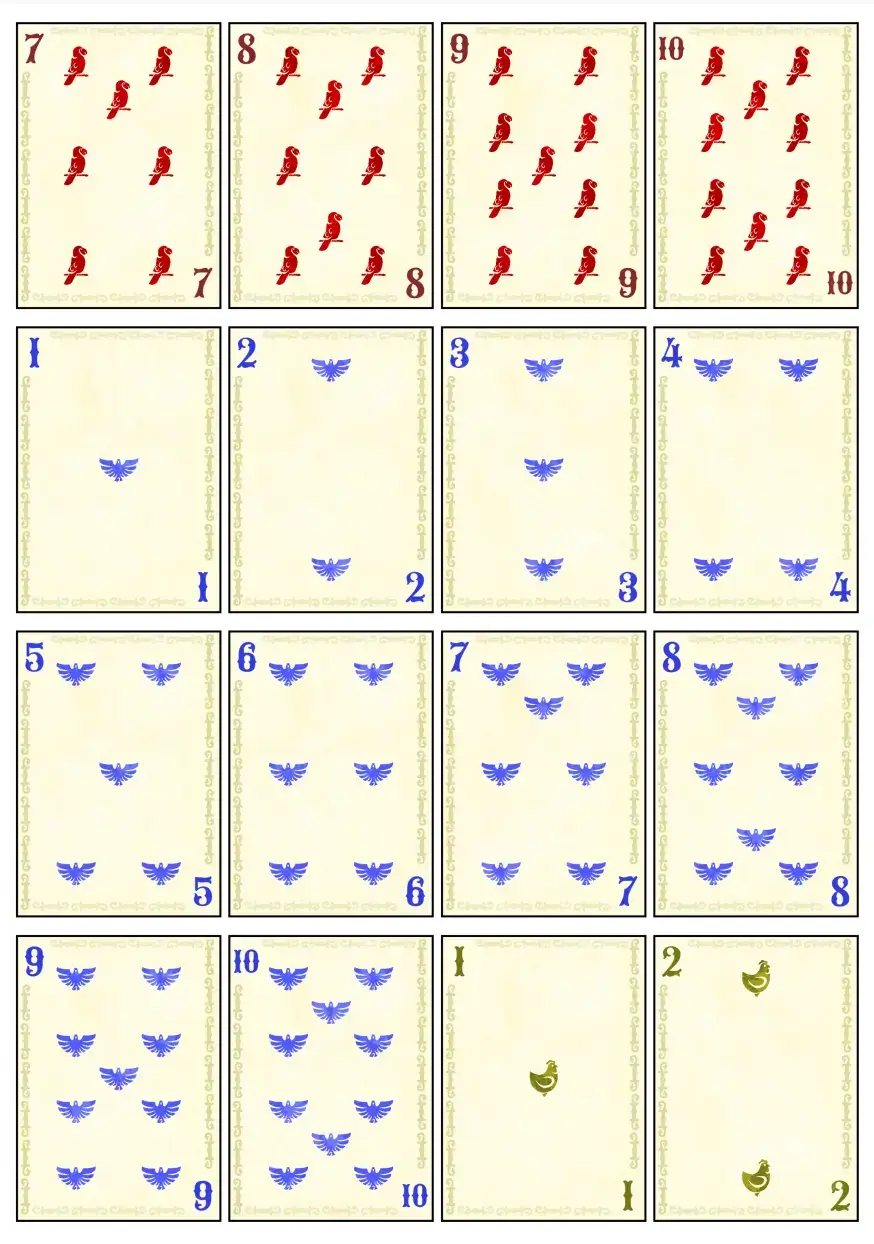
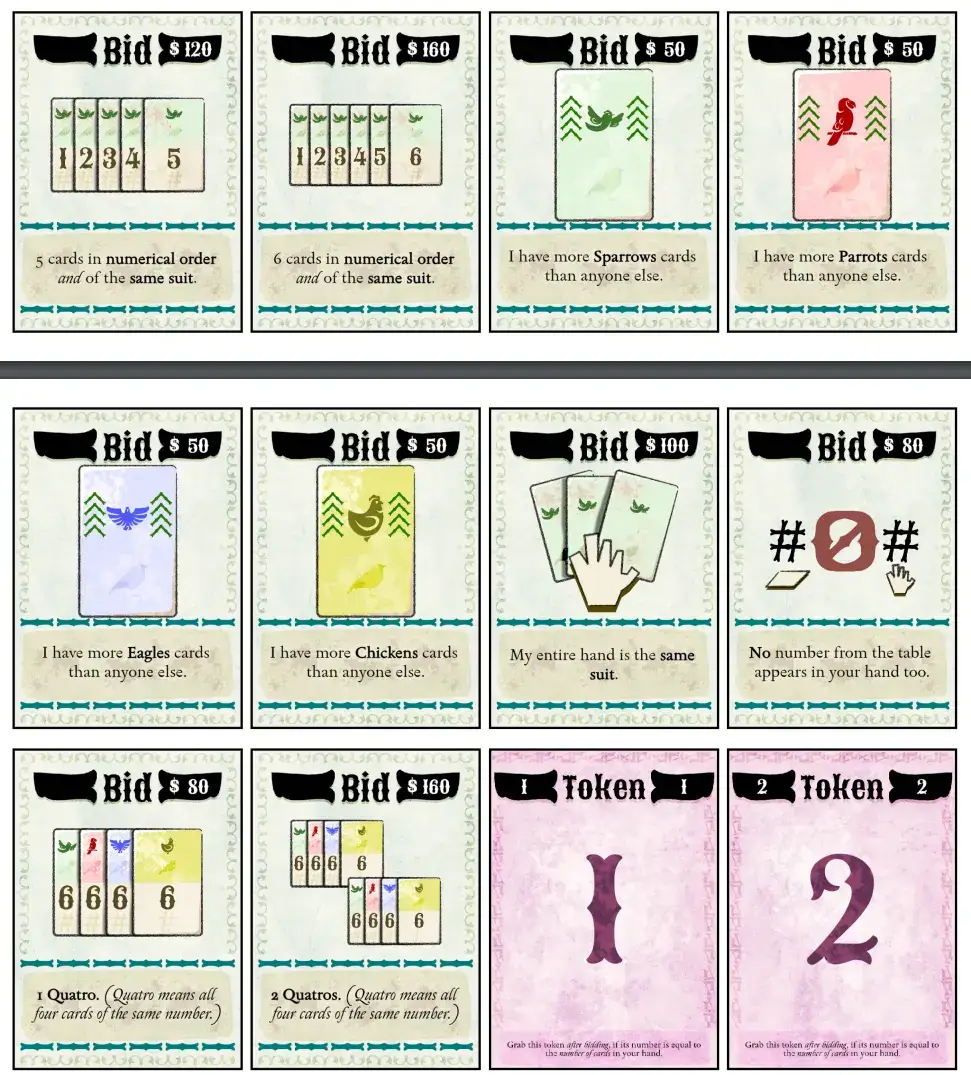
It’s clear that, if I actually take the time (even just a few extra hours) to put into the visual side of my games, they can look really great.
It’s also clear that my broken old laptop does not like this :p I could only generate this game in the smallest, most minimal mode, otherwise the visual processing was too heavy and it lagged and then crashed. I had to create the downloadable premade PDFs (at full size/strength) using some other shared device.
What I’ve been doing so far is still, I think, the best option. Most of my projects are considered “tiny” and I won’t spend too much time on art or details, but once in a while I pick one project where I purposely spend much more time making it really big and pretty and detailed. That’s the only way to keep up with my pace of ideas, without burning out.
Anyway, happy with how it all looks, pretty close to the original vision of some classic or antique game. (Also love me a good font with cool italics, which is why I use that font style a lot on the bid cards.)
Conclusion
Another tiny but really fun card game done! It’s a bit bigger than its twin game Bidding Blocks, but that’s because I purposely wanted everything tangible and on the table. You can play this game with a standard deck of cards; you’d only need to print the Bidding Cards + Tokens separately.
I feel this game accomplished what it set out to do. Poker, but simplified and more geared towards a casual audience, with the bluffing aspect traded for strategic bidding.
The theme/aesthetic I chose might work against that actually, by giving people the impression it’s this really serious grungy game. That’s why I tried to keep it simplistic, colorful, and clearly light-hearted.
But oh well, I try not to overthink these smaller projects. Just create the idea I have as best as I can, in a short time frame, then publish it to the world once polished and finalized. With this game, that happened quite easily, perhaps because of the solid backbone that poker combinations provided.
Until the next devlog,
Pandaqi